
Join DAC — a global community of independent Art & Collectibles experts
Help people discover the hidden cultural and collectible value of objects around them — and turn your professional expertise into part of a new decentralized expert network.
DAC connects people who need a professional preliminary assessment of artworks, antiques, jewelry, and other collectible objects with qualified experts from around the world. Our mission is to make early-stage expertise more accessible, more scalable, and more human.
Too many important objects remain unseen
Every year, potentially valuable artworks and collectibles stay unnoticed in private homes, family collections, storage rooms, and remote regions of the world. Many owners simply do not know what they have. In many cases, they also do not have practical access to qualified experts who can offer a professional first opinion.
DAC was created to help close that gap.
What is DAC?
DAC stands for Decentralized Art Consulting.
It is a global expert-driven system for remote preliminary assessment of physical collectible objects. People can submit information about an object, and DAC organizes its review through an independent expert cluster.
This is not a replacement for full in-person authentication or laboratory analysis. It is an intelligent, structured first step that helps identify whether an object may deserve deeper professional attention.
What makes DAC different is how expert opinions are processed.
Experts do not just provide separate, disconnected opinions. After the review is completed, all inputs are processed by a special mathematical algorithm based on Collective Intelligence theory.
This is where the "ci" in ciexpert.org comes from — Collective Intelligence.
To ensure objectivity and independence:
- All experts work anonymously
- All interaction happens online only
- Experts do not know who else is in their cluster
- No direct influence between participants is possible
This creates a clean environment for unbiased professional judgment and allows the system to extract a balanced, data-driven result from multiple independent opinions.
- Remote preliminary assessment
- Independent expert participation
- Structured expert clusters
- Collective Intelligence–based evaluation
- Anonymous expert interaction
- Human knowledge supported by mathematical models
- Access from anywhere in the world
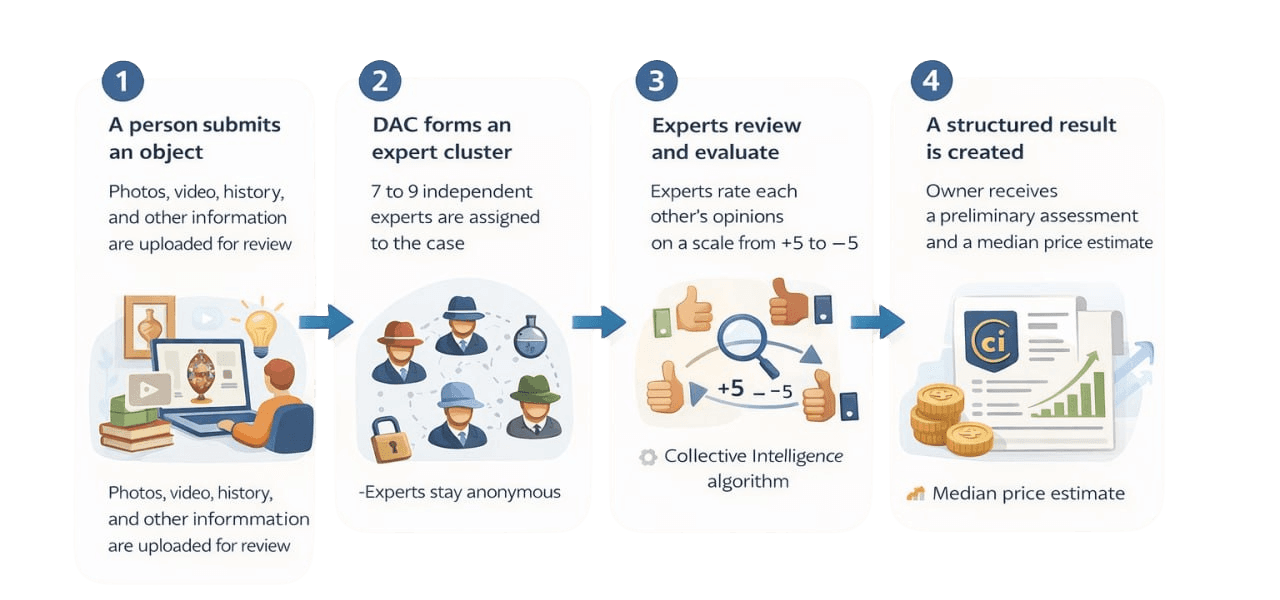
How DAC works
- 1
A person submits an object
Photos, video, description, known history, and other basic information are uploaded for review.
- 2
DAC forms an expert cluster
Depending on the complexity of the case, the object is assigned to a cluster of 7 to 9 experts, working independently and anonymously.
- 3
Experts review the object and evaluate each other's input
The process begins when the first expert submits their opinion. After that: All other experts evaluate that opinion using a scale from +5 to −5. Each next expert submits their own opinion. And again, all other experts evaluate it using the same scale. This continues until all expert opinions are submitted and evaluated. As a result, DAC collects not only expert opinions, but also peer evaluation data between experts.
- 4
The system creates a structured result
All collected data — both expert opinions and their mutual evaluations — are processed by the DAC algorithm based on Collective Intelligence principles. This allows the system to: identify stronger and weaker signals in expert input; reduce bias and noise; calculate aggregated values, including median price estimates and projected growth curves. The final result is a clear, structured preliminary assessment that helps the owner understand the object's possible artistic, historical, and collectible significance.
Why DAC matters
DAC helps make professional knowledge available to people who would otherwise never reach it.
This is especially important for those living far from major cultural centers, auction houses, museums, and expert institutions. A person in a small town or remote region may still have an object with real historical, artistic, or market importance.
DAC helps make that first connection possible.
Because cultural heritage should not stay hidden just because expertise is far away.
A new model for experts
DAC is also a new opportunity for professionals in the Art & Collectibles field.
It allows experts to contribute from anywhere in the world, join specialized review clusters, and share their knowledge in a flexible, structured, and rewarded way.
In that sense, DAC is a new kind of global infrastructure for expert work — a practical, decentralized network where professional skills can be applied across borders and time zones.
- Work remotely
- Join cases that match your specialization
- Contribute to meaningful discoveries
- Receive compensation for your work
- Help shape a new expert ecosystem
- Build your professional presence inside an international network
Who can apply
We welcome applications from professionals with real experience in areas such as:
If your background can help identify, interpret, compare, or evaluate physical cultural and collectible objects, we would like to hear from you.
How expert admission works
Joining DAC is based on application and review.
Candidates are invited to complete a special application form. Each application is reviewed by members of the DAC founding committee. Approved applicants receive the right to participate in expert work inside the DAC ecosystem.
Our goal is to build a strong, independent, and credible community of experts from different countries, disciplines, and professional traditions.
Building a global expert commons
DAC is more than a service. It is the beginning of a new professional community.
We believe expert knowledge in Art & Collectibles should be more open, more connected, and more useful to people everywhere. By bringing together independent specialists into decentralized expert clusters, DAC creates a new way for knowledge to circulate — and for important objects to be recognized before they disappear from view.
Become part of the DAC expert community
Join a growing international network of professionals helping people discover the objects that may matter — financially, historically, and culturally.
Applications are reviewed by the DAC founding committee.